
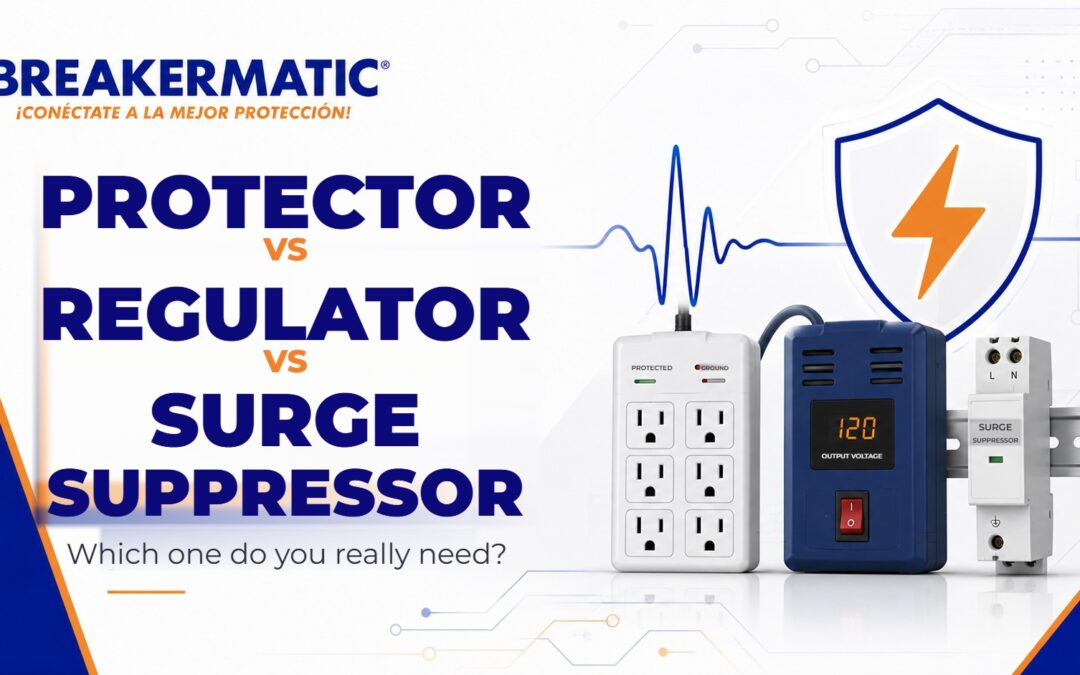
A protector disconnects when the voltage goes outside the safe range; a regulator corrects the voltage; and a surge suppressor limits very short-duration transient overvoltages.
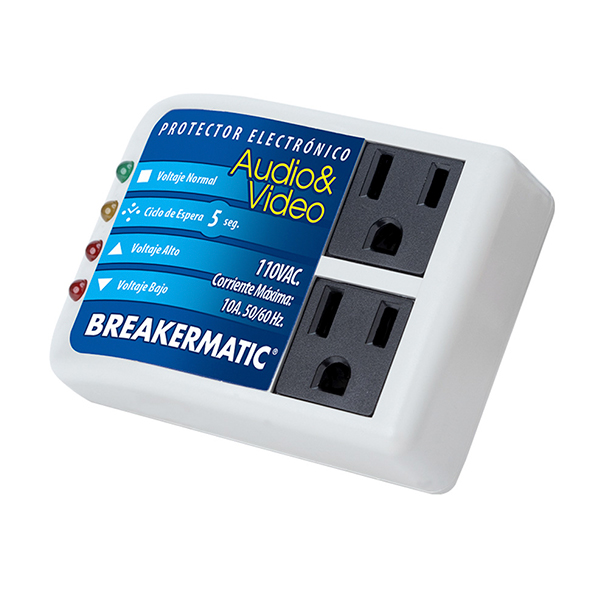
Voltage protector
Monitors the voltage and isolates the load when the voltage goes outside the defined limits.
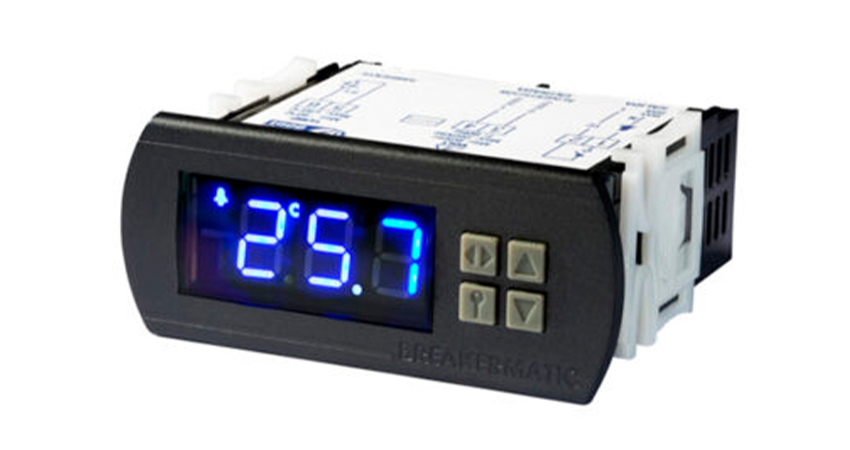
Regulator
Adjusts the output voltage to keep it within usable values while operating within its range.
Surge suppressor
Reduces very short-duration overvoltages associated with switching, load operations or electrical events.
1. Voltage protector: when the right thing is to disconnect
An electronic protector continuously monitors the supply voltage. If it detects that the voltage stays above or below the set values, it disconnects the load before the equipment keeps running under a potentially harmful condition.
When the grid returns to normal, some protectors also include a standby cycle before reconnecting.
- Compressors and refrigeration
- Air conditioners
- Motors and motor pumps
- Equipment with circuit boards
- Inverter systems
2. Voltage regulator: when you need to correct the voltage
A regulator serves a different function. Instead of immediately disconnecting the load in the face of certain variations, it is designed to adjust the output voltage and keep it within usable values.
variable voltage → regulation → more stable output voltage.
This solution may be necessary when a process requires continuity and the input variations are within the device’s regulation capacity.
But regulation doesn’t mean absolute protection. A regulator has electrical limits and should not be confused with a device specifically designed to handle transients.
3. Surge suppressor: protection for events that last a very short time
Transient overvoltages can be caused by load switching, grid switching or nearby atmospheric events.
A SPD or surge suppressor is designed to limit these overvoltages and reduce the energy that reaches sensitive equipment.
Having protection against high and low voltage doesn’t automatically mean having adequate protection against transients. And having a suppressor doesn’t mean being protected against a prolonged low-voltage condition either.
So, which one should you use?
It depends on the fault you want to control.
| Electrical problem | Main solution |
|---|---|
| Sustained low voltage | Protector / regulation depending on the application |
| Sustained high voltage | Voltage protector |
| Correctable supply variations | Regulator |
| Short-duration spikes or transients | Surge suppressor / SPD |
| Immediate reconnection after a failure | Protector with standby cycle |
| Short circuit or overcurrent | Breaker or fuse |
This last point is important: a breaker doesn’t replace these functions either. Its role against overcurrents and short circuits addresses a different problem.
In professional installations, the right protection is usually built in layers.
Electrical protection is also easier to understand when you see it
Breakermatic complements its solutions with technical and demonstration content. This video brings the article’s explanation into a quick, visual format.
Tip: before selecting a protection device, identify the type of load and the electrical condition you need to control.
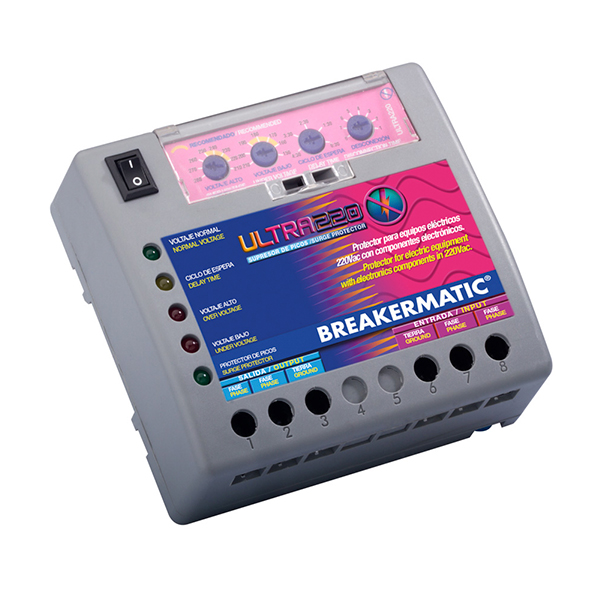
Watch the video directly on YouTubeULTRA 220 Surge Suppressor
In this family, Breakermatic combines high and low voltage monitoring, an adjustable standby cycle and transient overvoltage suppression for refrigeration, climate control, motor and electronic or inverter equipment applications.
The right question isn’t “which one is better”
A regulator isn’t better than a protector. A suppressor doesn’t replace a regulator, and a breaker doesn’t replace these protections either.
Each device responds to a different electrical condition. In commercial and industrial installations, selection should start by identifying the load, the rated voltage, the current, the electronics involved and the disturbances present on the grid.
Only then is the protection selected.
Technical sources
Frequently asked questions
Does a surge suppressor protect against low voltage?
Not necessarily. An SPD is designed to limit transient overvoltages. A sustained low or high voltage condition requires a specific monitoring, disconnection or regulation function depending on the application.
Does a regulator replace a voltage protector?
Not necessarily. A regulator tries to correct the voltage within its operating range; a protector can disconnect the load when the voltage is no longer within the values defined as suitable.
Can these protections be combined?
Yes. Some devices include several functions. The Breakermatic ULTRA 220 Surge Suppressor family combines high and low voltage monitoring, a standby cycle and transient overvoltage suppression.
Technical note: the selection, coordination and installation of protection devices should be carried out according to the characteristics of the load, the installation and the manufacturers’ recommendations, and by qualified personnel.