
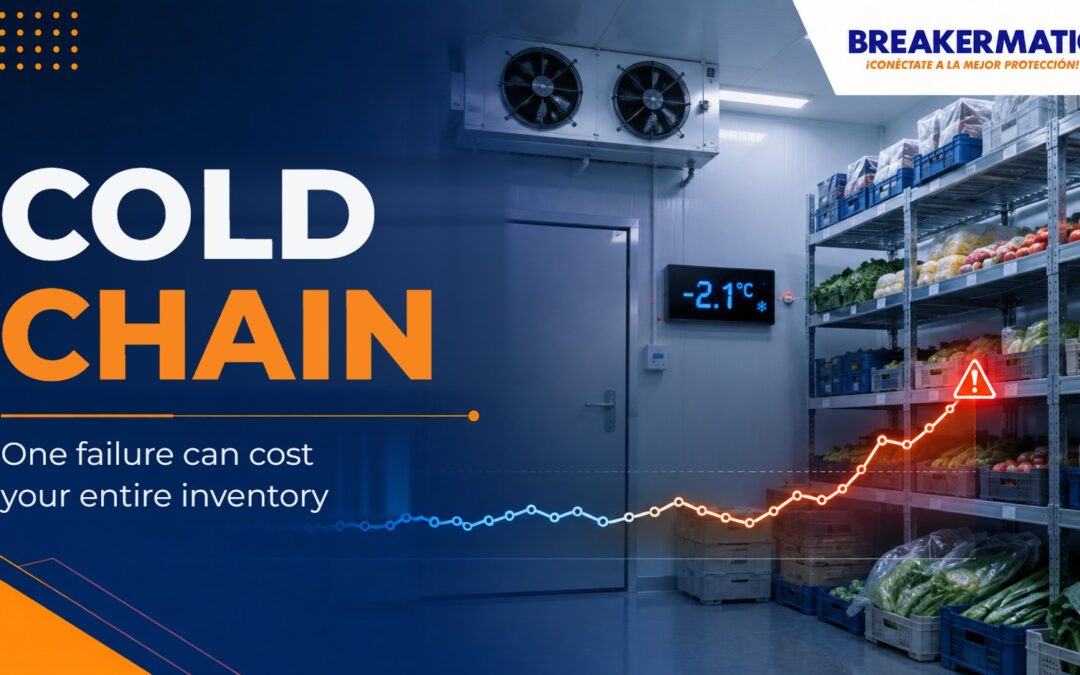
Cold chain: how to prevent losses from temperature and voltage failures
An effective cold chain needs three things: refrigeration, temperature monitoring and the ability to react to a failure. If one of them is missing, the product can be put at risk even if the equipment keeps running.A cold room can be switched on, making noise and apparently working normally… while the stored product starts drifting out of its temperature range.
That is one of the costliest risks in the cold chain: the failure isn’t always visible when it starts.
In supermarkets, restaurants, pharmacies, laboratories, hotels, butcher shops and distribution centers, a temperature variation can compromise food, beverages, raw materials or sensitive products long before anyone notices there’s a problem.
That’s why the cold chain isn’t just about “having refrigeration”. It’s about maintaining the right temperature, monitoring it and reacting when it stops being safe.
The problem doesn’t start when the compressor shuts off
A refrigerated system depends on several elements working together: compressor, sensors, temperature control, ventilation and power supply.
A door left open too long, a poorly placed sensor, a compressor losing performance or a power failure can change the internal temperature.
The critical detail is time.
For foods that require temperature control, for example, bodies such as the FDA set specific cold-holding limits. For pharmaceutical products and vaccines, monitoring can be even stricter and requires procedures specific to each product and regulation.[1][2]
Measuring temperature completely changes the operation
This is where a fundamental tool comes in: the temperature supervisor.
Its job isn’t to produce cold. Its job is to monitor what is really happening inside the refrigerated environment.
If the temperature rises above or falls below the limits defined for the application, an alarm makes it possible to detect the deviation before relying solely on a visual inspection or discovering the problem when the product is already compromised.
The World Health Organization applies this same principle in highly controlled cold chains: monitoring thermal exposure is an essential part of managing the system.[2]
The logic also applies to commercial refrigeration: what isn’t measured can hardly be managed.
CAT-711: monitor before you lose
And here Breakermatic has a particularly interesting solution.
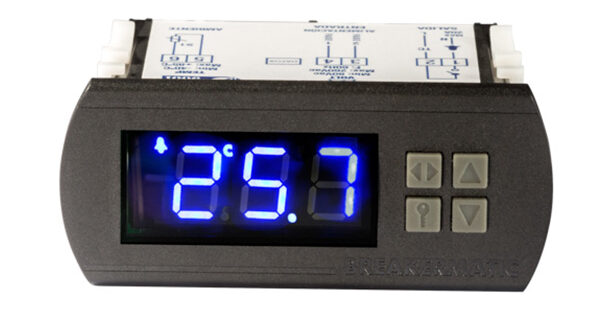
The CAT-711 is a temperature supervisor with a programmable alarm designed to monitor refrigerated environments.
It works with an NTC probe and can measure temperatures from -40 °C to 40 °C, with a resolution of 0.1 °C. It is also multi-voltage and can operate between 80 and 260 VAC.[3]
This makes it possible to use it as an additional layer of supervision in applications where knowing about a temperature deviation is as important as producing cold.
On its own, it doesn’t prevent every cause of a cold chain break. Its value lies precisely elsewhere:
making visible a condition that could otherwise go unnoticed.
Monitoring is not the same as controlling
This difference is important for any technician.
A supervisor lets you know what is happening.
A controller, on the other hand, can use that measurement to act on the system.
The Breakermatic CTP-711, for example, is designed to control temperature in cold rooms, refrigerated cabinets, display cases, beverage coolers, pastry displays and other preservation applications that don’t require specific additional defrost, ventilation or humidity functions.[4]
This opens up two different levels within an installation:
supervision: knowing whether the temperature has left the range;
control: acting on the system to maintain the set temperature.
And there’s still a third layer.
Temperature also depends on electricity
A cold room can have an excellent controller and still be vulnerable if the power supply is unstable.
Low voltage can affect compressor operation. A blackout stops refrigeration. And a reconnection that’s too fast can cause the compressor to try to start before the pressures in the refrigeration circuit have equalized.
That’s why electrical protection and temperature control shouldn’t be treated as separate problems.
For conventional 220 V refrigeration equipment, Breakermatic offers solutions such as the ULTRA 220 AT, which monitors high and low voltage, disconnects the load in the event of a fault and lets you set a standby cycle before reconnection.[5]
That delay can also be used to stagger the startup of several units and reduce current peaks when there are multiple refrigeration loads.
The cold chain is protected in layers
A professional installation can be understood much better like this:
Electrical protection → refrigeration equipment → temperature control → supervision and alarm → stored product.
Each layer addresses a different risk.
The protector looks after the equipment’s power supply.
The refrigeration system produces the cold.
The controller maintains the programmed condition.
The supervisor warns when the temperature stops behaving as it should.
And it all exists for one reason: protecting the product and the continuity of the operation.
Breakermatic: from protecting the equipment to protecting the process
In commercial refrigeration, a failure can cost much more than repairing a compressor.
It can mean lost inventory, operational interruptions and products that can no longer be used.
That’s why Breakermatic develops solutions that work at different points in the system: voltage protection, controls and temperature supervision.
For applications where refrigerated environments need to be monitored, the CAT-711 Temperature Supervisor with Programmable Alarm is a direct option to consider.
And when the system’s temperature also needs to be controlled, the Breakermatic family of controllers makes it possible to move toward more complete refrigeration management.
Because in the cold chain, protecting doesn’t just mean preventing a machine from failing.
It means preventing a failure from turning into a loss.
FAQ
What is the cold chain?
It is the set of controlled temperature conditions that must be maintained during storage, handling or transport to properly preserve a sensitive product.
Why monitor a cold room if it already has a thermostat?
Because controlling and supervising are different functions. A supervisor makes it possible to detect and alert on temperature deviations even when the system appears to keep running.
What does the Breakermatic CAT-711 do?
It monitors temperature through an NTC probe and lets you program alarms to warn when the refrigerated environment reaches conditions defined by the user.
Does the same temperature range work for food, medicines and vaccines?
No. Each product has specific requirements and there may be particular regulatory standards. That’s why the operating range must be defined according to the product and the application.
Technical sources
[1] FDA — Food Code and cold holding. The FDA Food Code is a technical reference for food safety in retail and food service; for certain foods that require time/temperature control, it sets cold holding at 5 °C (41 °F) or below.
[2] WHO — Cold chain monitoring. The WHO has specific guidelines on temperature monitoring during storage and transport and considers monitoring devices an integral part of vaccine cold chain management. This illustrates why measuring thermal exposure, rather than just trusting that the refrigerator is on, is a fundamental principle of control.
[3] Breakermatic CAT-711. Its spec sheet lists an NTC probe range of -40 °C to 40 °C, a resolution of 0.1 °C, a power supply between 80 and 260 VAC and a programmable alarm.
[4] Breakermatic CTP-711. Breakermatic describes it as a 110–220 VAC multi-voltage controller for cold rooms, refrigerated cabinets and display cases and preservation applications without specific additional needs for resistive defrost, ventilation or humidity.
[5] Breakermatic ULTRA 220 AT. Model PBE220-AT0EST is 220 VAC, 40 A, with adjustable high/low voltage and a standby cycle adjustable between 2:00 and 4:30 minutes; Breakermatic lists applications in refrigeration, air conditioning and motors