
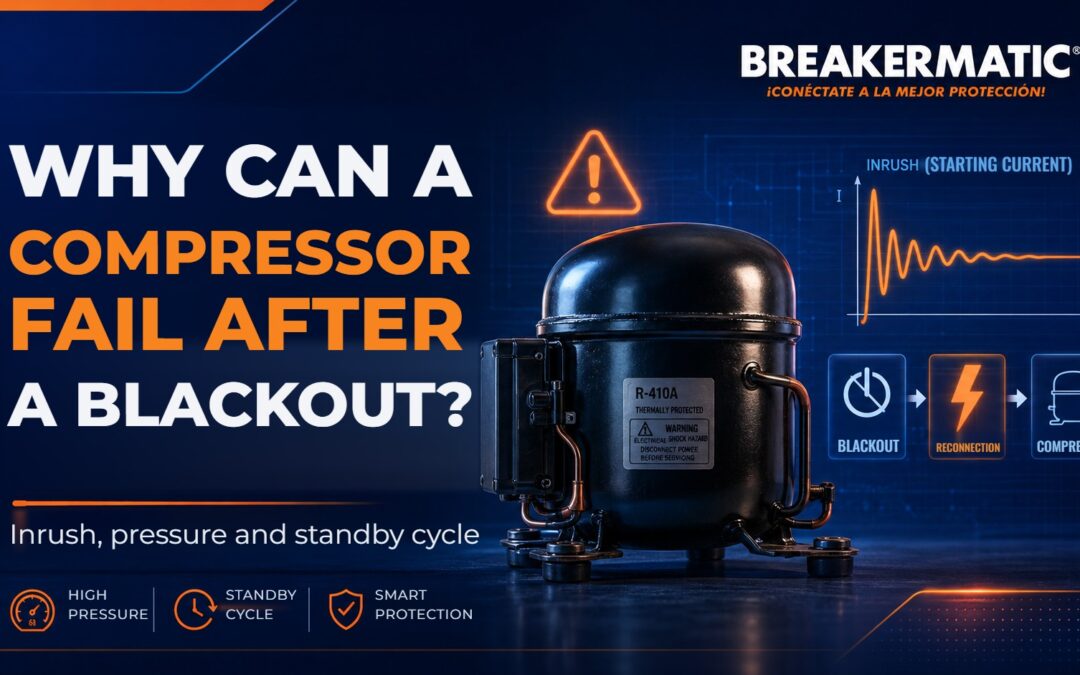
A compressor can be put at risk after a blackout when it tries to restart too soon, while the grid is unstable or before the system pressures have equalized. The standby cycle prevents that immediate reconnection.
A blackout doesn’t necessarily damage a compressor. The critical moment usually comes a few seconds later: when the power comes back and the unit tries to start again.
Refrigerators, cold rooms, display cases, air conditioners and other systems rely on the compressor to move refrigerant. After a brief interruption, three unfavorable conditions can coincide: a power grid that is still unstable, high current demand at startup and system pressures that have not yet equalized.
Understanding those few seconds helps explain why the standby cycle.
Inrush: the electrical shock of startup
When a conventional compressor starts, the motor needs considerably more current than during normal operation. This phenomenon is known as starting current or inrush current.
In fixed-speed compressors with direct-on-line starting, that current can be several times the rated current.
Under normal conditions, the system is designed to handle it. The problem arises when the compressor tries to start repeatedly after very short outages, under low voltage or while the system is still under load.
Each new attempt means another electrical and mechanical strain.
The second problem: the pressure isn’t ready yet
When a refrigeration system stops, the high and low pressures don’t necessarily equalize right away.
If power returns too quickly, the compressor may try to start before the system reaches suitable conditions. That’s why compressor and HVAC control manufacturers use anti-short-cycle strategies: a minimum off time before allowing a new start.
That time allows the system to move toward pressure equalization and prevents a rapid succession of starts and stops. It also helps preserve proper lubrication conditions.
What about inverter compressors?
Here there’s an important difference.
Inverter compressors use power electronics to gradually control the motor speed. Thanks to soft starting, they can drastically reduce inrush current compared to a conventional direct-on-line compressor.
But that doesn’t mean they are immune to electrical problems.
There is now another critical component: the control electronics and the inverter drive. An installation with inverter equipment must consider both the compressor’s characteristics and the electrical limits defined by the manufacturer.
Conventional or inverter, the technical rule remains the same: the unit must resume operation within the conditions it was designed for.
So, what does the standby cycle actually do?
A standby cycle, or reconnection delay, prevents the unit from restarting immediately after a power failure.
Its function is simple:
power failure → disconnection → wait → normal conditions → reconnection.
There is no universal time that applies to all compressors. The right value depends on the unit’s design and the manufacturer’s specifications. For example, Danfoss recommends a three-minute delay for certain families of scroll compressors, while other applications use different times.[3]
That detail matters: protection should be selected according to the equipment, not the other way around.
When electrical protection also protects the compressor
This is where a suitable voltage protector does more than simply detect whether “there’s power”.
It can monitor the supply, disconnect the load when the voltage goes outside the set limits and prevent the unit from restarting immediately after the failure.
Breakermatic applies this principle in solutions for refrigeration, air conditioning and electric motors. For example, the ULTRA 220 AT features adjustable cut-off voltages and standby cycle, while the Aire INVERTER 220 line is designed specifically for air conditioners and electronically controlled refrigeration equipment.

FAQ
How long should a compressor wait after a blackout?
There is no universal time. It depends on the compressor and the system. Some manufacturers specify delays of around three minutes, while other applications require different values. The technical specification should always be followed.
What is compressor inrush?
It’s the high current the motor can draw during startup. In conventional direct-on-line compressors it can be several times higher than its normal current.
What is the standby cycle for?
It prevents an immediate restart after an interruption, helping avoid short cycling and allowing the system to approach suitable pressure conditions before reconnecting.
Technical sources supporting this article
[1] Danfoss — Inverter technology for HVAC. Danfoss explains that a conventional direct-on-line compressor can draw around 5–6 times its rated current during startup, while the soft start of inverter systems greatly reduces inrush.
[2] Copeland — HVACR System Components. Copeland notes that anti-short-cycle controls set minimum times between cycles to allow pressure equalization and proper lubrication, preventing starts and stops that are too frequent.
[3] Danfoss — Application Guidelines DCJ. For a specific scroll family, Danfoss recommends a restart timer and documents a three-minute timeout; that’s why “3 minutes” should not be presented as a universal rule for every compressor.
[4] Breakermatic ULTRA 220 AT. The current model is 220 VAC, 40 A, with adjustable cut-off voltages and a standby cycle adjustable between 2:00 and 4:30 minutes; Breakermatic explains that this delay allows pressures to equalize before reconnecting refrigeration and A/C equipment.
[5] Breakermatic Aire INVERTER 220 Y. It is designed for mini-splits and inverter/electronically managed refrigeration; according to its spec sheet, it features high/low voltage cut-off, delay and transient suppression.