
Switching on the light, turning on the TV or charging your phone seems simple. But behind that everyday gesture lies one of the most complex and impressive processes in modern engineering.
The electricity that reaches your home isn’t born there. It travels hundreds —even thousands— of kilometers, goes through multiple transformations and passes through different systems before reaching an outlet.
And at each of those steps… it can lose stability.
It all starts with power generation
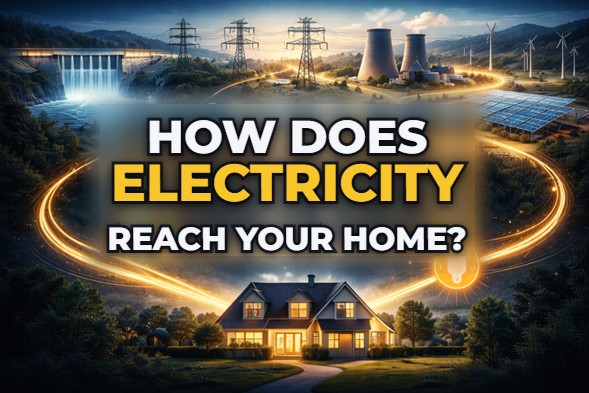
Electricity is produced in large power plants designed to turn different sources into usable energy.
In Latin America, one of the main sources is hydroelectric power: the movement of water in dams spins turbines that generate electricity continuously.
There are also thermal power plants, which use fuels to produce heat and generate energy; solar farms, which convert sunlight into electricity; and wind farms, where the wind drives large turbines.
In other countries, nuclear power also plays an important role, generating large amounts of electricity from controlled reactions.
Although the source may vary, the goal is the same: to produce enough energy to supply entire cities.

The journey: how electricity travels long distances
Once generated, electricity can’t travel just as it is produced.
To travel long distances without losing efficiency, its voltage is stepped up to very high levels using transformers. This allows the energy to be carried through transmission lines that connect entire regions.
These power grids are enormous. They cross mountains, rivers and cities, carrying energy from generation centers to the points of consumption.
But along that route, electricity is exposed to multiple factors: weather conditions, overloads, technical failures or service interruptions.
Each of these events can cause voltage variations.
From high voltage to your home
Before reaching your home, electricity goes through substations where the voltage is gradually reduced to levels that are safe for household use.
Finally, the energy enters your home at a standard voltage (generally between 110 and 120 volts in many countries in the region), ready to power your appliances.
But here something key happens: electricity no longer arrives “perfect”.
After the whole journey, small fluctuations are normal. And in some cases, these variations can be more aggressive than they seem.
The invisible problem: power isn’t always stable
Even if you don’t notice it, the voltage in your home can rise or fall at different times of the day.
It can happen when:
- there are blackouts and the power comes back
- high-consumption devices are switched on
- there are faults in the grid
- or even due to external conditions such as storms
These variations are one of the main causes of appliance damage.
A voltage spike can affect electronic circuits in seconds.
A drop can strain motors and cause silent wear.
And the trickiest part is that the damage is often not immediate.
More advanced technology, greater sensitivity
Today, homes are full of smart devices: TVs, computers, game consoles, digital appliances.
All of these devices run on high-precision electronics.
That means they need stable power to work properly. And when they don’t get it, their lifespan is shortened.
Protecting the power means protecting your devices
This is where a reality many people ignore comes in:
You can’t control how energy is generated or how it travels…
but you can control how it enters your home.
Electronic voltage protectors are designed to act at that critical point. They detect when the voltage goes outside a safe range and cut off the power, preventing it from reaching your devices.
When the grid stabilizes, they allow it to reconnect safely.
They don’t eliminate problems on the grid, but they do prevent those problems from turning into damage.
From generation to your outlet: a chain you need to take care of
The electricity you use every day is the result of a complex, dynamic and, in many cases, imperfect system.
From a dam, a solar panel or a power plant all the way to the outlet in your home, energy goes through multiple stages where it can change, fail or become unstable.
And along that route, your appliances are the last link.
Protecting them isn’t overdoing it. It’s understanding how the whole system works.
Start where you do have control
Energy will keep traveling, changing and evolving.
But in your home, the decision is yours.
Discover solutions designed to protect your devices against electrical fluctuations