
OLED, QLED and Mini LED seem to compete. But they don't work the same way.
Buying a TV can be confusing. Every year there are more names and more technologies.
However, you don't need to know every technical detail. First you need to understand what really changes from one screen to another.
Then you can decide which technology best fits your living room, your budget and the way you watch TV.
OLED stands out for its blacks and contrast. QLED offers color, brightness and a wide range of prices. Mini LED improves lighting control and can reach very high brightness.
OLED vs QLED vs Mini LED: the difference in a nutshell
OLED
Each pixel can control its own light. That's why it achieves very deep blacks and great contrast.
Ideal for: movies, gaming and dark rooms.QLED
It uses quantum dots together with LED backlighting. This helps improve color and brightness.
Ideal for: everyday use and a range of budgets.Mini LED
It uses smaller LEDs in the backlight. That way it can control light more precisely.
Ideal for: HDR, sports and bright rooms.QLED and Mini LED can exist in the same TV
This is one of the most common points of confusion. QLED and Mini LED don't describe exactly the same part of the screen.
QLED is mainly related to the use of quantum dots to improve color. On the other hand, Mini LED describes a more advanced form of backlighting.
That's why a TV can use both technologies at the same time.
What makes an OLED TV different?
OLED stands for Organic Light Emitting Diode.
Its biggest difference is in the light. Each pixel can be turned on or off individually.
That's why a black area can stay completely dark. At the same time, the pixel next to it can still show a bright image.
The result is usually very high contrast. In addition, OLED offers very fast response times.
What does QLED really mean?
QLED uses quantum dots to improve color. However, it still relies on LED backlighting.
That combination can produce vivid colors. In addition, many models reach good brightness levels.
QLED has another advantage too: it comes in a huge range of prices.
So don't assume that every QLED TV belongs to the premium range.
Why can Mini LED improve the picture so much?
Mini LED describes the backlight.
Instead of using larger LEDs, it uses much smaller light sources. That's why a manufacturer can fit more zones behind the screen.
This allows better control over which part of the image receives light. As a result, it can improve brightness, contrast and HDR.
However, the number of zones doesn't tell the whole story. The algorithm that controls those zones also matters.
OLED vs QLED vs Mini LED: quick comparison
There is no perfect technology for everyone. This table summarizes where each one usually stands out.
| Feature | OLED | QLED | Mini LED |
|---|---|---|---|
| Blacks | ★★★★★ | ★★★ | ★★★★ |
| Contrast | ★★★★★ | ★★★ | ★★★★ |
| Brightness | ★★★★ | ★★★★ | ★★★★★ |
| Gaming | ★★★★★ | ★★★★ | ★★★★ |
| Bright room | ★★★★ | ★★★★ | ★★★★★ |
| Dark-room movies | ★★★★★ | ★★★ | ★★★★ |
| Price range | Medium | Very high | Medium / high |
| Burn-in | There is a risk | Very low | Very low |
Which is best for each use?
Movies and series
Blacks and contrast matter a lot.
First choice: OLEDFootball and motion
Look for brightness, processing and a good refresh rate.
First choice: Mini LEDConsole or PC
Fast response can make a big difference.
First choice: OLEDFamily and streaming
Price, brightness and balance matter more.
First choice: QLEDBurn-in and blooming: two concepts you should know
OLED: what is burn-in?
Burn-in is the permanent retention of static elements. It can happen after prolonged exposure.
However, the risk depends a lot on usage. Someone who watches varied content doesn't use the panel the same way as a screen that shows the same graphic for many hours.
Mini LED: what is blooming?
Blooming appears as a small halo around bright objects on dark backgrounds.
It can happen because a backlight zone lights up an area larger than the object. Good zone control helps reduce it.
QD-OLED and RGB Mini LED: what's next is already arriving
OLED, QLED and Mini LED are also evolving. Two technologies deserve special attention heading into 2027.
QD-OLED
It combines an OLED panel with quantum dots. It aims to keep OLED's blacks while improving color volume.
RGB Mini LED
It uses red, green and blue light sources in the backlight. It aims to improve brightness and color.
So, which TV should you buy?
The answer depends on how you're going to use it. That's why it's best to start with your main priority.
You want contrast
You watch a lot of movies, play games and often use your TV at night.
Priority: blacks + contrast + response.You want balance
You want good color, brightness and plenty of price options.
Priority: value + variety.You need brightness
You have a lot of natural light or watch sports and HDR content.
Priority: brightness + lighting control.Don't buy a TV just for its acronym
This is one of the most common mistakes. OLED, QLED or Mini LED only describe part of the experience.
Also, two models with the same technology can perform very differently.
OLED, QLED or Mini LED: they all depend on the power grid
Display technologies work in different ways. However, they all contain electronics.
That's why it's also worth thinking about the power supply.
Proper protection can disconnect the equipment when the voltage goes outside the set range.
Some protectors wait before powering the TV back on.
These are fast events that require a specific suppression function.
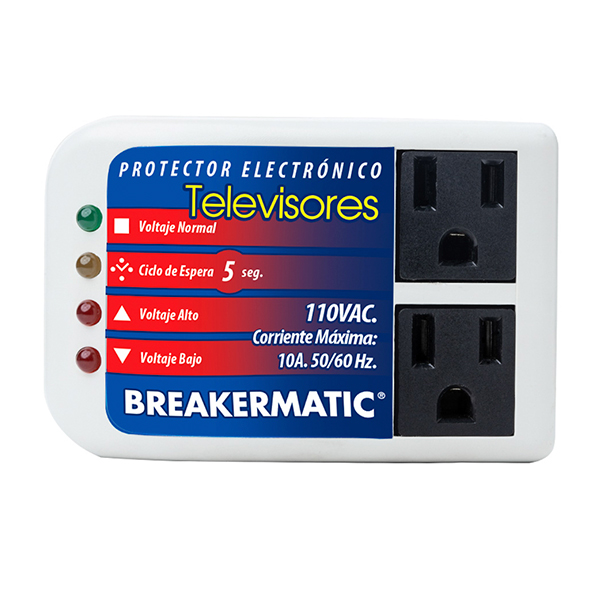
Breakermatic PTV110-000EST
Electronic protector designed for TVs and entertainment equipment compatible with 120 VAC.
It also includes functions against certain high and low voltage conditions. It also includes transient surge suppression.
See the protector →Frequently asked questions about OLED, QLED and Mini LED
Is OLED better than QLED?
Not always. OLED stands out in blacks, contrast and response. QLED, on the other hand, offers many price options and can reach good brightness.
Is Mini LED better than QLED?
They aren't mutually exclusive technologies. A TV can use quantum dots and Mini LED backlighting at the same time.
Is Mini LED the same as OLED?
No. Mini LED uses a backlight. OLED controls light at the pixel level.
Which TV is best for a bright room?
A good high-brightness Mini LED or QLED usually works very well. However, performance depends on the model.
Which is best for watching movies?
OLED usually has an advantage in dark rooms. Its deep blacks help create a very high-contrast image.
Which is best for gaming?
OLED usually stands out for its response time. It's also worth looking for 120 Hz, HDMI 2.1, VRR and low input lag.
Can OLED suffer from burn-in?
Yes, that risk exists. However, it depends on usage and how long static elements stay on screen.
What protector does a Smart TV need?
First check the TV's voltage and power consumption. For equipment compatible with 120 VAC, Breakermatic offers the PTV110-000EST model.
Sources and references
- RTINGS — QLED vs OLED
- RTINGS — Mini LED vs OLED
- Samsung — Neo QLED and Quantum Mini LED
- TCL — Mini LED technology
- Breakermatic — PTV110-000EST technical sheet.